|
Martial Arts are very popular at the Studio. We offer our students, highly experienced teachers. We now run a class in Tai Chi, Ju Jitsu, Tae Kwondo (ITF), Wing Chun and Capoeira (details below).
We will also be offering classes in Kung Fu, Karate and Kick Boxing.
Aikido
|
|
Aikido Arts
Ki Exercises
Ki Meditation
Ki Breathing
Kiatsu
Misogi
|
|
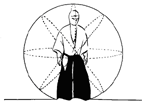
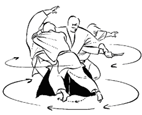
Aikido means "The way to union with the Ki of the universe". The universe signifies nature itself. Ki-Aikido is the way to learn how to become one with the universe through the Ki Principle of "Mind moves body". To "become one with universe" means to understand the universal mind.
Everybody has a mind and body. Mind and body are originally one. Our body is visible therefore we can understand its existence easily. However, the mind is invisible therefore we tend to forget about it. It is difficult to know your own mind correctly. The mind moves body always. If your mind is positive, your body is also positive.
Ki Development Classes
The fundamental purpose of Ki training is unification of mind and body. Ki development classes teach us how to maintain unification of mind and body in our daily lives. This means we will be able to perform to the best of our ability in all circumstances.
Ki exercises teach how to move and exercise the body without losing your balance or mind and body unification. They also help developing correct posture and how to maintain mind and body unification in a variety of different postures.
Ki breathing is whole body breathing which not only promotes health but mental calmness as well.
Ki mediation strengthens the state of mind and body unity at a deep subconscious level to fully integrate what you have learned in the other methods.
Kiatsu therapy is a method of directly or indirectly sending Ki to an injured or weakened part of the body thereby rejuvenating the life force and enabling the body to heal itself.
Misogi purpose is to unify mind and body in the midst of chaos. The word misogi comes from the Shinto religion and means "to go to the river and cleanse oneself". This word is used in Aikido for certain breathing and meditation exercises because they have a cleansing effect on the mind and body.
The teacher
Jayesh Karadia is a Shodan, 1st Dan Black belt. He has been teaching since 2001. He has his qualifications as a Coach (Britsh Aikido Board) and First Aid at work.
|
Tae Kwondo
|
TAE Jumping or flying, to kick or smash with the foot.
KWON To punch or destroy with the fist.
DO The art or way.
|

|
Tae Kwon-Do is a form of unarmed combat for the purpose of self-defense, which is achieved through intensive physical and mental training. It is a martial art that has no equal in power or technique.
Tae Kwon-Do training is beneficial for everybody. The student can train for self-defense, promoting self confidence and physical skills. If dedicated enough, the student can develop high technical standard to reach senior blackbelt status and eventually become a master.
THE 5 TENETS OF TAE KWON-DO.
These values and ideals are the foundations from which students training in Tae Kwon-Do will develop and attain:
~ COURTESY ~ INTEGRITY ~ PERSEVERANCE ~SELF-CONTROL ~ INDOMITABLE SPIRIT
|
Jitsu
First class FREE!
|
Self-Defence Classes Held at Templeton House Studio
|

|
Jitsu is a martial art based on a moving system of striking, locking and throwing techniques. With a strong emphasis on the use of an opponent's body weight and movement, Jujitsu provides a highly effective means of countering physical attacks from both armed and unarmed assailants, irrespective of the defender's own strength, weight or gender.
Jujitsu is an art of degrees. Students are taught to tailor their defence to the level appropriate to the attack. There is no justification for hospitalising someone just because they grabbed hold of your wrist. Jujitsu is connected to its history. We still use Japanese names and terminology for our techniques, and can trace our lineage back to Japan.
We are never far from violence. Jujitsu provides a safe and controlled forum to explore violence, without hurting each other. When you leave the dojo, you leave the violence behind you. Practitioners of the martial arts don't start fights.
Because Jiu Jitsu does not rely on strength it can be practised by: Men and women and people of any size Bookings or enquiries, please call or email
See also the Jitsu website: www.jitsufoundation.org
|
Wing Chun with Sifu Tam
|
|
|
Originally a martial art created by a woman and which still uses the same principles today. This effective self-defence system is particularly advantageous in close-up situations as you borrow your opponent’s force to defeat them, and do not need to rely on your own strength. As such this system is exceptionally useful for both sexes and for people of any age.
Wing Chun is a very practical, logical and efficient system of self-defense. It evolved out of the need for a system that was highly practical but did not take a lifetime to learn.
Wing Chun relies on sensitivity and the redirection of force when dealing with an opponent, as opposed to meeting force with force, as is displayed in other styles of martial arts, i.e. karate. This makes it suitable for all ages and sexes.
The core concept of Wing Chun is that of economy of motion, i.e. the shortest distance between two points is a straight line. And so attacks, counter-attacks, parries, etc. will always take the most direct route.
- Easy to learn but challenging
- Practical: To attack is to defend
- Develop automatic Reflex Action
- Physically flexible
- Very Effective Self-Defence
- sticking Hands: Blocking Superfluous
- Fluid Movements Hardness & Softness used in harmony
According to legend, Ng Mui studied the White Crane style before she ever invented WingTjun. The name of course, comes from her first student, Yim Wing Tjun, also a woman.
The story goes that she taught her system to Yim Wing Tjun so that she could defend herself against a local bully. As far as we know, WingTjun is the only kung fu system developed by a woman and it is more than 250 years old! This might also be the reason that Wing Tjun is concerned with the conservation of energy, so you don't need to develop the kind of impressive, but ultimately clumsy power of a bodybuilder, in order to overcome your opponent.
In the beginning, WingTjun was taught from Fatshan, a town in Southern China. Most of the teachers there operated a closed-door policy, which led to much controversy about the different WingTjun interpretations practised today.
The different spellings are used to differentiate the teacher's different interpretations of the same style. This is why you find WingTsun, Wing Chun, Ving Tsun, Wing Tchun and our own WingTjun! (Actually, WingTjun is phonetically closer to the Cantonese pronunciation for this system than any of the other spellings.) But the real difference is that WingTsun and WingTjun are the most logical and integrated systems of all.
Although all are essentially the same style, incorporating the three forms, Siu Nim Tau, Chum Kiu and Biu Tze, as well as the Wooden Dummy, the Eighth-Cutting Knives (Butterfly knives or Double-Broadsword), and the Long Pole.
Sifu Tam's in-depth studies of traditional Shaolin Kung Fu, Tai Chi, Kickboxing, Taekwondo & grappling has served to improve his understanding of Martial Arts in its entirety, and continues to assist him in being the best Instructor he can be.
Capoeira

Self Defence ~ Dance ~ Martial Arts ~ Acrobatics ~ Music
Capoeira possesses a very unique style that brings together beauty and power, developing mental balance, physical conditioning, self-defence, music and a profound sense of art, all at once. Capoeira can be done by anyone of any age or size. More than a martial art, Capoeira is also a social event filled with tradition and history.
Self Defence
|
WITH SENSEI TASSIE SINCLAIR
(4TH DAN)
|
|
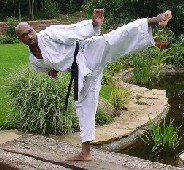
|
Self defense isn't about empowerment, personal gain, winning, revenge or teaching
those who have hurt you a lesson. Those are the motivations of an attacker.
Self-defense is about effectively ending an attack, quickly and with minimum
damage to yourself. If you have those other motivations, then you aren't defending
yourself, you're fighting. And if you are fighting, you are just as guilty of misconduct
as your so-called attacker, because you are both operating from the same selfish motives.
For info or bookings: or
|